
TIME TRAVEL TRIVIA PASSPORT ARCHIVE SERIES
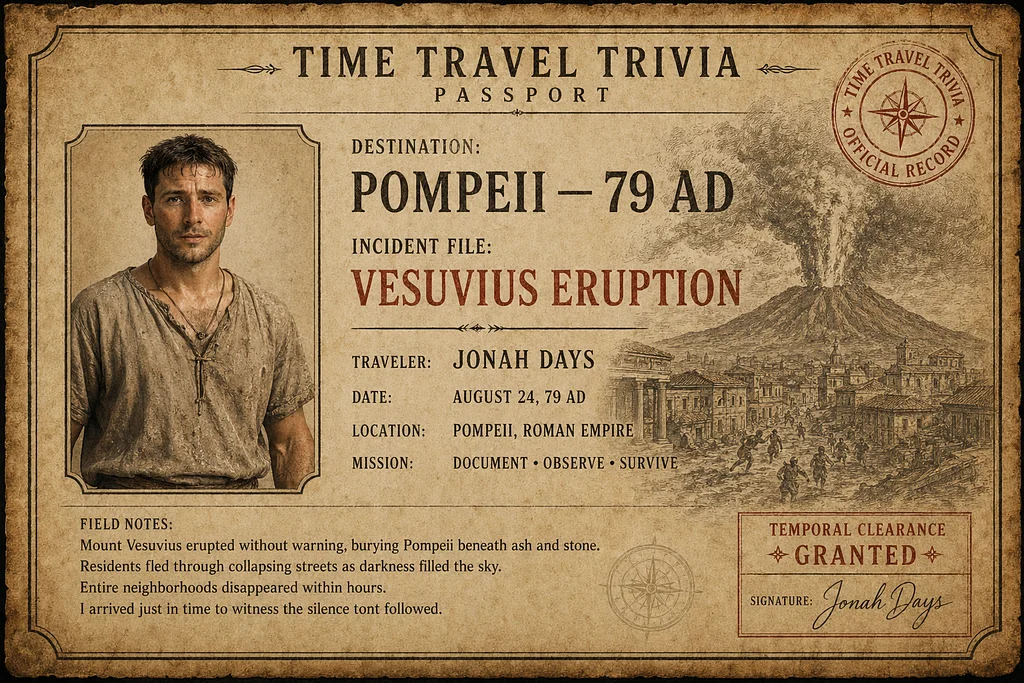
VESUVIUS ERUPTION
This clearance confirms Jonah Days’ arrival in Pompeii on August 24, 79 AD, shortly before Mount Vesuvius produced a towering eruption column rising more than 20 miles into the atmosphere above the Bay of Naples. Falling pumice began accumulating across streets and courtyards within hours, collapsing tiled roofs under increasing weight as residents attempted evacuation along the Via Stabiana and coastal roads toward the harbor. By nightfall, daylight had vanished beneath ash clouds so dense that witnesses later described the darkness as deeper than any storm. Archive notes record successive pyroclastic surges moving across the city at extreme speed, burying buildings beneath volcanic debris and preserving entire neighborhoods in place for nearly two millennia. Entry classified as a rapid-onset Plinian eruption with catastrophic atmospheric and environmental impact.



THE GREAT CHICAGO FIRE
This authorization documents Jonah Days’ presence during the Great Chicago Fire of October 8–10, 1871, when drought conditions, strong southwest winds, and densely packed wooden construction allowed flames to spread across more than 2,000 acres of the city. Firebrands carried across the Chicago River ignited additional districts despite natural firebreak expectations, accelerating the destruction of business blocks, rail yards, and residential neighborhoods. The disaster destroyed over 17,000 structures and displaced roughly one-third of the city’s population—nearly 100,000 residents—within two days. Field observations describe collapsing grain elevators, crowded evacuation routes toward Lake Michigan’s shoreline, and a skyline transformed into a continuous wall of flame visible for miles across the prairie. Entry classified as a high-intensity urban firestorm event with wind-driven propagation beyond a conventional fire.


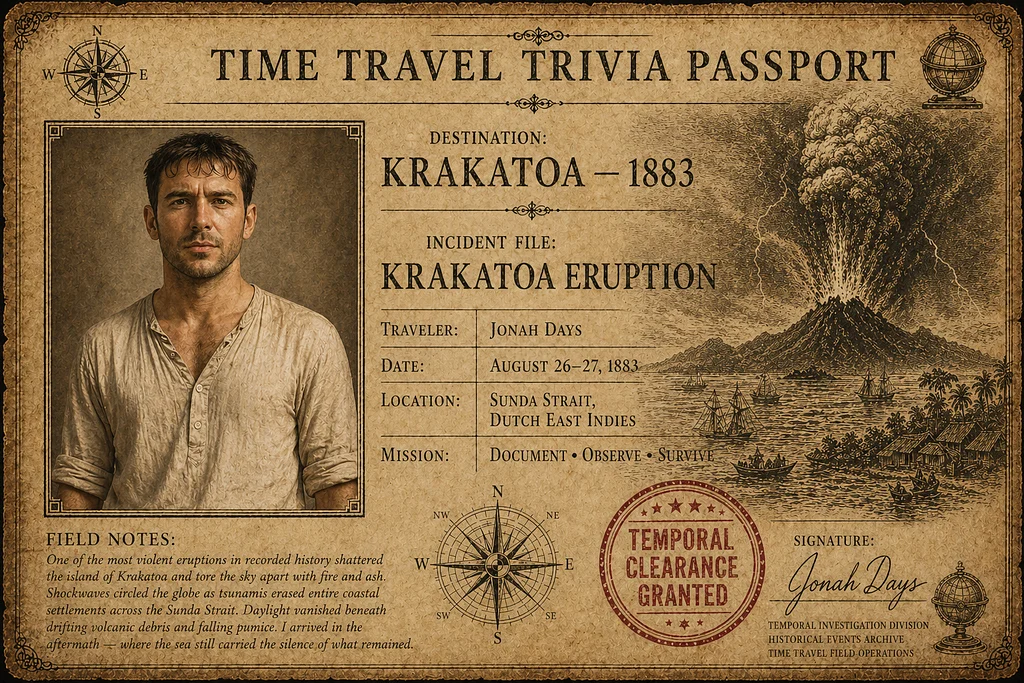
KRAKATOA ERUPTION
This passport entry verifies deployment to the Sunda Strait during the August 26–27, 1883, destruction of Krakatoa, one of the most violent volcanic eruptions in recorded history. Four massive explosions culminated in the collapse of much of the island’s volcanic structure, generating shockwaves detected around the globe and producing the loudest sound ever recorded in modern human observation. Tsunami waves exceeding 30 meters in height struck the surrounding coastlines of Java and Sumatra, destroying hundreds of settlements and killing tens of thousands of residents. Archive notes describe drifting pumice rafts covering the sea surface, daylight reduced to twilight across regional shipping lanes, and atmospheric ash dispersal that later produced vivid red sunsets worldwide for months. Entry classified as a multi-phase caldera-collapse eruption with global climatic and environmental consequences.





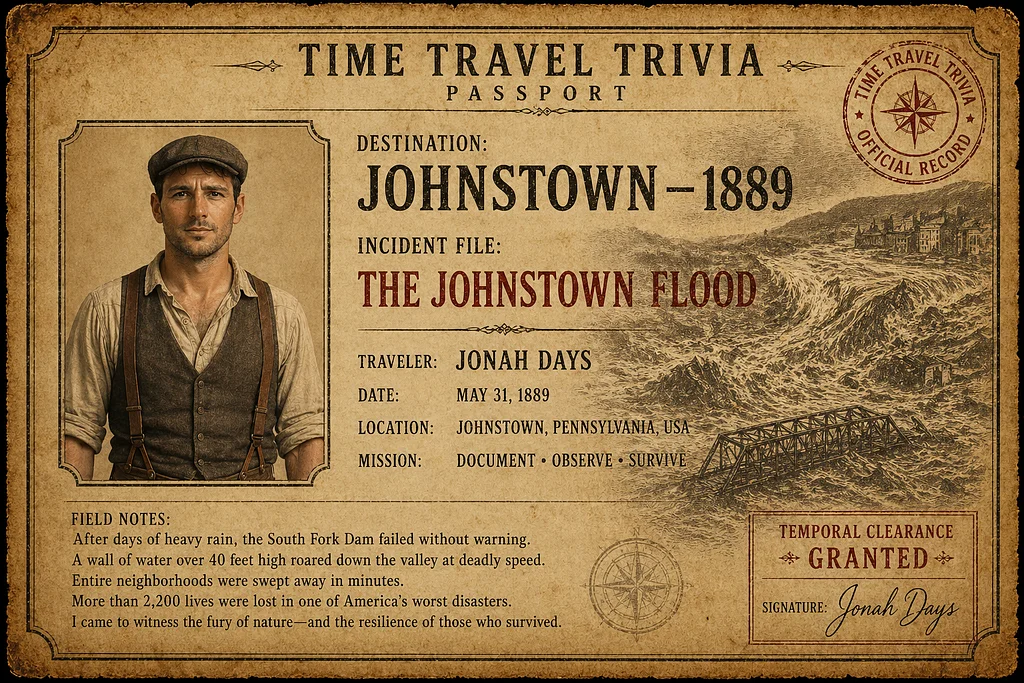
THE JOHNSTOWN FLOOD
This clearance confirms Jonah Days’ arrival on May 31, 1889, immediately following the catastrophic failure of the South Fork Dam after days of heavy rainfall across the Allegheny Mountains. An estimated 20 million tons of water surged down the Conemaugh Valley in a wave more than 40 feet high, traveling at speeds approaching 40 miles per hour and carrying locomotives, factory equipment, bridges, and entire houses into the city. Debris accumulated against the Pennsylvania Railroad Stone Bridge, forming a temporary barrier that later ignited in a massive fire lasting several days. Archive records document widespread structural destruction, nearly complete loss of downtown districts, and more than 2,200 fatalities—making the disaster one of the deadliest in United States history. The entry is categorized as a catastrophic infrastructure failure that results in urban destruction due to extreme flooding.





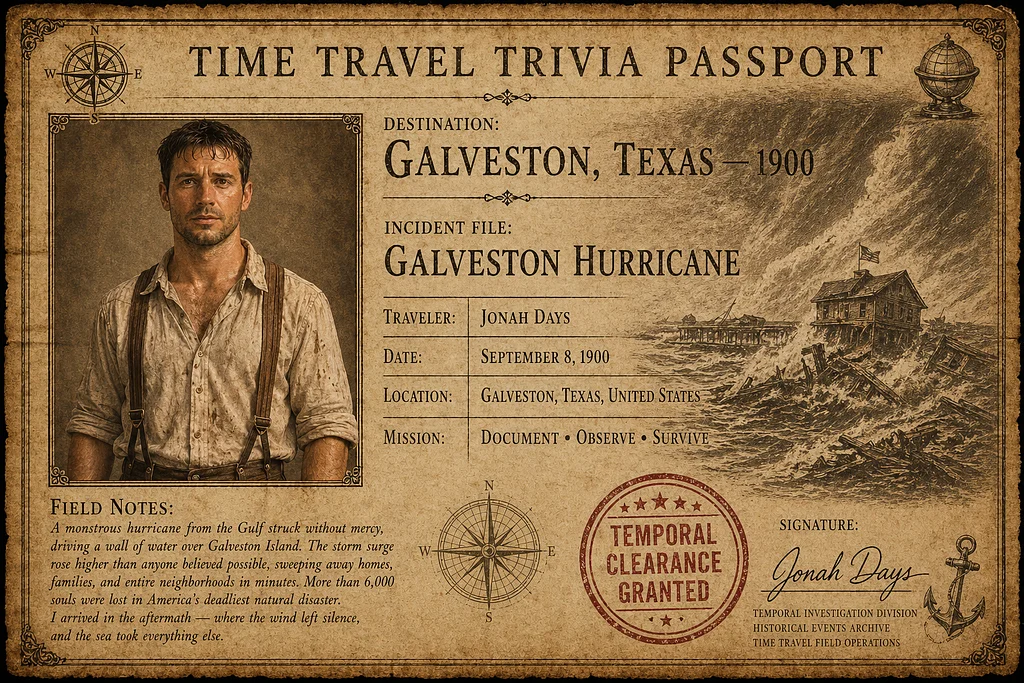
GALVESTON HURRICANE
This record places Jonah Days on Galveston Island on September 8, 1900, during a Category 4 hurricane that produced storm surge exceeding 15 feet above normal tide levels across the low-lying barrier island. Without a seawall in place at the time, Gulf waters advanced across the entire city, lifting buildings from foundations and carrying them inland as winds estimated near 135 miles per hour destroyed homes, wharves, and telegraph infrastructure. Communication with the mainland failed early in the event, leaving residents without warning of the storm’s full strength until evacuation was no longer possible. Archive notes describe debris-choked streets, overturned railcars, and widespread structural collapse across coastal districts, with loss of life later estimated between 6,000 and 8,000 people—the deadliest natural disaster in United States history. The entry is classified as a high-fatality storm surge coastal impact event, resulting in the total failure of infrastructure.





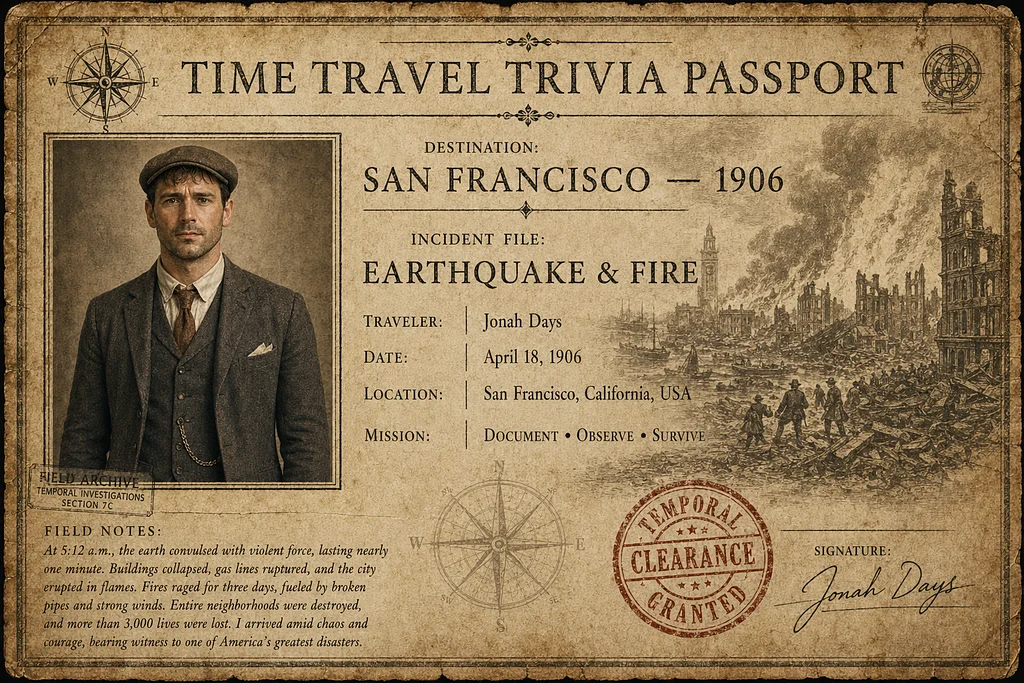
EARTHQUAKE & FIRE
This archive clearance document confirms Jonah Days’ presence during the April 18, 1906 rupture of the San Andreas Fault, when a magnitude ~7.8 earthquake struck San Francisco at approximately 5:12 a.m., producing violent ground displacement across more than 290 miles of California terrain. Streets split apart, masonry structures collapsed instantly, and water mains failed throughout the city, leaving firefighters unable to contain the dozens of ignition points caused by ruptured gas lines and overturned stoves. Fires burned uncontrolled for three days, consuming entire districts including Market Street and the waterfront warehouses. Over 28,000 buildings burned down, and more than 250,000 residents fled as evacuation camps formed in Golden Gate Park and along the Presidio. The entry is classified as a combined seismic rupture and infrastructure-failure firestorm event of unprecedented scale.







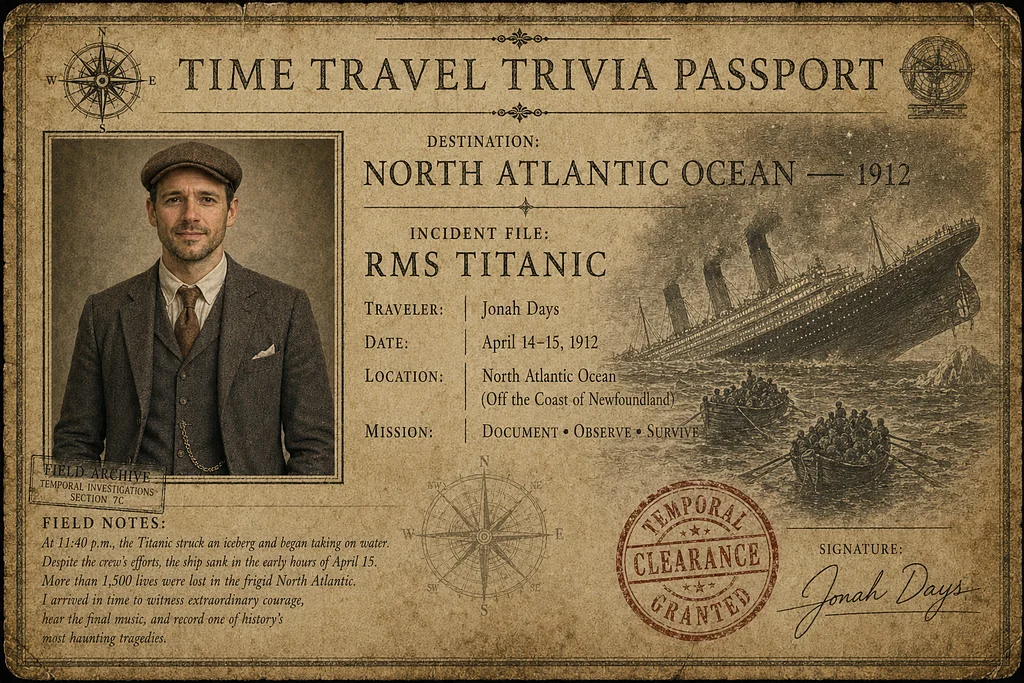
RMS TITANIC
This passport entry confirms Jonah Days’ arrival during the sinking of the RMS Titanic on April 14–15, 1912, after the liner struck an iceberg at approximately 11:40 p.m. ship’s time while traveling at near cruising speed through the North Atlantic ice field. Six forward watertight compartments were breached, exceeding the vessel’s survivable design limits and initiating progressive flooding along the bow. Because of limited capacity and slow evacuation procedures, lifeboats were launched unevenly, leaving more than 1,500 passengers and crew members in waters that were almost freezing (about −2°C). Archive notes show that distress rockets lit up the night sky, the stern slowly rose during the last submersion at about 2:20 a.m., and lifeboats floated among debris fields until RMS Carpathia came to the rescue. Entry classified as a cold-water maritime mass-casualty event.






HALIFAX EXPLOSION
This clearance document confirms Jonah Days’ presence in Halifax Harbour on December 6, 1917, following the collision between the ammunition ship SS Mont-Blanc and the relief vessel SS Imo, which ignited a cargo of high explosives including TNT, picric acid, and benzol fuel. Approximately twenty minutes after the collision, the resulting detonation released an energy blast equivalent to nearly three kilotons of TNT, flattening the Richmond district and generating a pressure wave that shattered windows up to 50 miles away. A harbor-generated tsunami followed the blast, sweeping debris inland along the shoreline. Archive observations describe anchor fragments falling miles from the epicenter, fires spreading through collapsed neighborhoods, and widespread structural destruction that left nearly 2,000 dead and thousands more injured. Entry classified as a large-scale wartime harbor explosion with a secondary wave impact event.



THE HINDENBURG DISASTER
This passport record verifies Jonah Days’ arrival on May 6, 1937, during the destruction of the German passenger airship Hindenburg while attempting to dock at the Lakehurst Naval Air Station mooring mast following a transatlantic crossing from Frankfurt. As the airship maneuvered into position approximately 200 feet above ground, ignition occurred near the stern section, rapidly spreading across the hydrogen-filled lifting cells and engulfing the structure in flames within roughly 34 seconds. The forward hull briefly remained intact before collapsing toward the ground as crew and passengers attempted escape from observation windows and gangways. Archive notes describe eyewitness crowds gathered beneath the landing corridor; broadcast radio coverage of the incident in real time; and the destruction of the world’s largest rigid airship—effectively ending the era of transatlantic passenger zeppelin travel. The entry is classified as a rapid structural aviation tragedy event that received high press coverage.






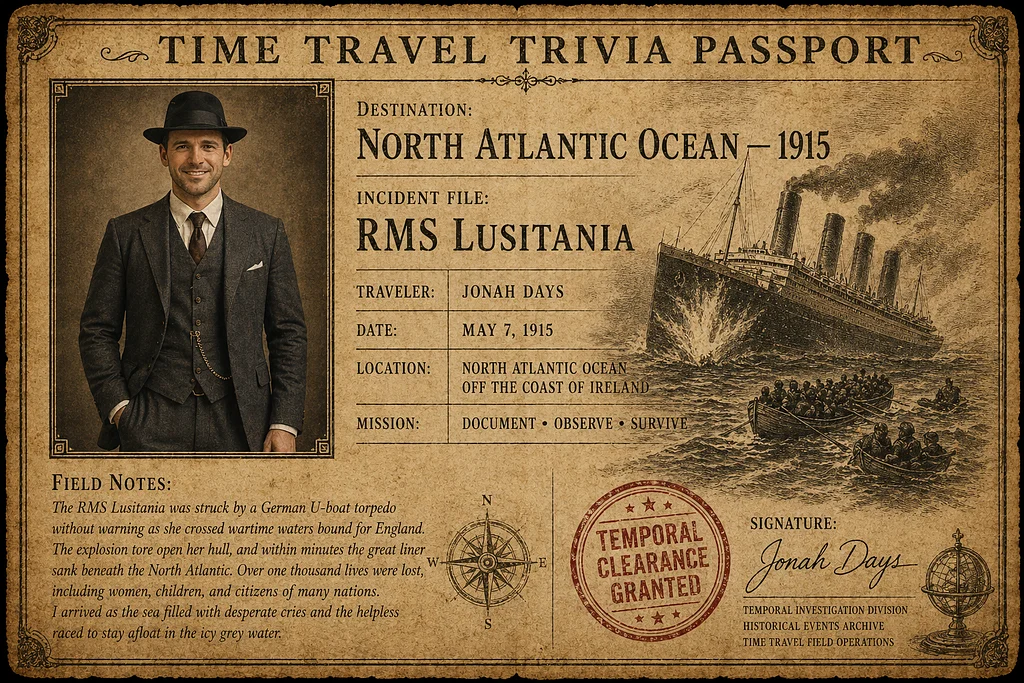
RMS LUSITANIA
This clearance confirms Jonah Days’ presence on May 7, 1915, during the torpedoing of the RMS Lusitania by German submarine U-20 off the southern coast of Ireland near the Old Head of Kinsale. A single torpedo struck the starboard bow, followed by a secondary internal explosion that accelerated flooding and caused the liner to list heavily within minutes. The vessel sank in approximately 18 minutes, leaving little time for organized lifeboat deployment and forcing many passengers into cold Atlantic waters. Of the 1,959 people aboard, nearly 1,200 were lost, including citizens of multiple neutral nations. Field records document chaotic evacuation conditions, overturned lifeboats along the listing deck, and the diplomatic shockwaves that followed the disaster, which intensified international pressure on Germany during the First World War. Entry classified as a wartime maritime strike with major geopolitical consequences.


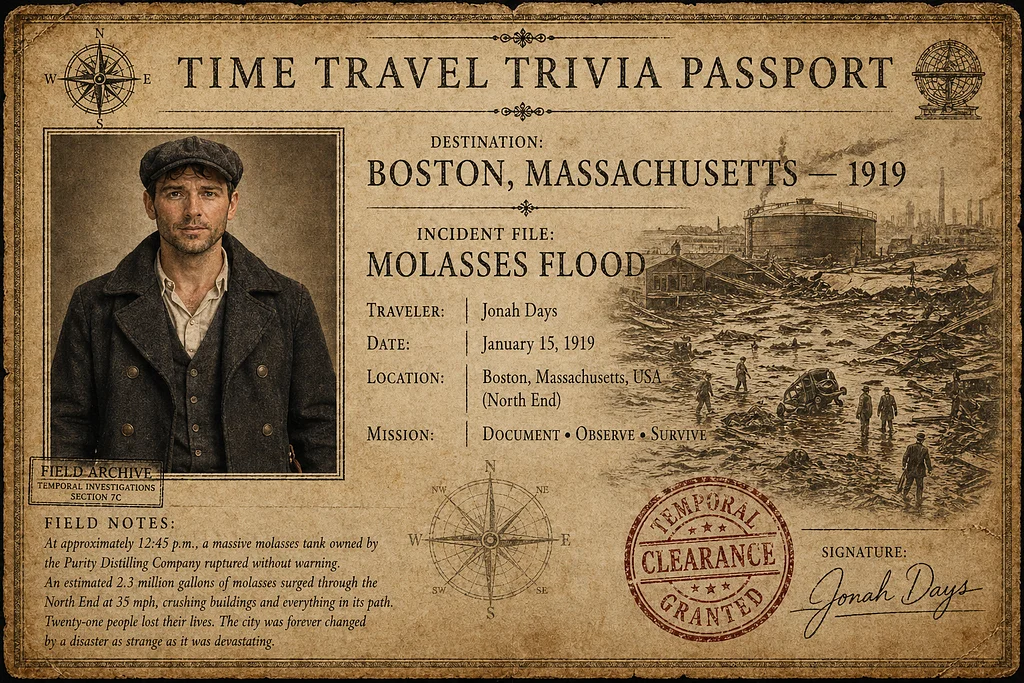
MOLASSES FLOOD
This clearance confirms Jonah Days’ arrival in Boston’s North End on January 15, 1919, shortly before the sudden structural failure of a 50-foot-high storage tank owned by the Purity Distilling Company released approximately 2.3 million gallons of industrial molasses into surrounding commercial and residential streets. Witnesses reported unusual metallic groaning from the riveted steel tank prior to rupture as winter temperatures rose unexpectedly, increasing internal pressure within the partially fermented contents. A dense wave estimated at nearly 25 feet in height moved along Commercial Street at speeds approaching 35 miles per hour, displacing railcars beneath the Atlantic Avenue Elevated Railway and collapsing adjacent warehouses, timber structures, and waterfront facilities. Telegraph lines failed across the district as debris and hardened syrup residue obstructed rescue access routes. Entry classified as a catastrophic industrial storage tank rupture causing devastation to the surrounding area.







YANGZI–HUAI FLOODS
This clearance confirms that Jonah Days arrived in the Yangzi and Huai River basins of central China during July–August 1935, when heavy seasonal monsoon rainfall caused river systems to exceed flood-stage capacity across large agricultural areas and transport corridors. Low-lying villages constructed along levee networks and irrigation channels were progressively submerged as embankments weakened under sustained hydraulic pressure, allowing floodwaters to spread outward across thousands of square kilometers of cropland and settlement areas. Rail lines connecting regional market towns became impassable, telegraph communication was interrupted in multiple counties, and evacuation relied primarily on wooden river craft navigating newly formed inland waterways where roads had previously existed. Archive observations show continuous precipitation, saturated soil conditions, and overflow from converging tributaries, causing widespread displacement that affects several million residents. The river basin experienced a large-scale monsoon-driven flooding event that caused long-lasting regional areas to be submerged in flood waters.








DUST BOWL — BLACK SUNDAY STORM
This archive clearance document confirms Jonah Days’ presence across the southern Great Plains during the May 11–12, 1934 dust storm sequence, when prolonged drought and extensive mechanized overplowing left millions of acres of topsoil exposed to powerful frontal winds moving eastward from Colorado and Kansas. As wind velocities intensified, airborne soil formed dense rolling dust fronts that reduced daylight visibility to near zero across Oklahoma and Texas Panhandle settlements. Farmsteads were abandoned as livestock suffocated and irrigation systems failed beneath drifting sediment deposits. Rail transport slowed or halted entirely, and electrical infrastructure suffered repeated interruption. Atmospheric transport carried an estimated 350 million tons of soil across the continent, depositing measurable dust as far away as the Atlantic coast. Archive observations confirm widespread agricultural collapse and forced migration affecting hundreds of thousands of residents.








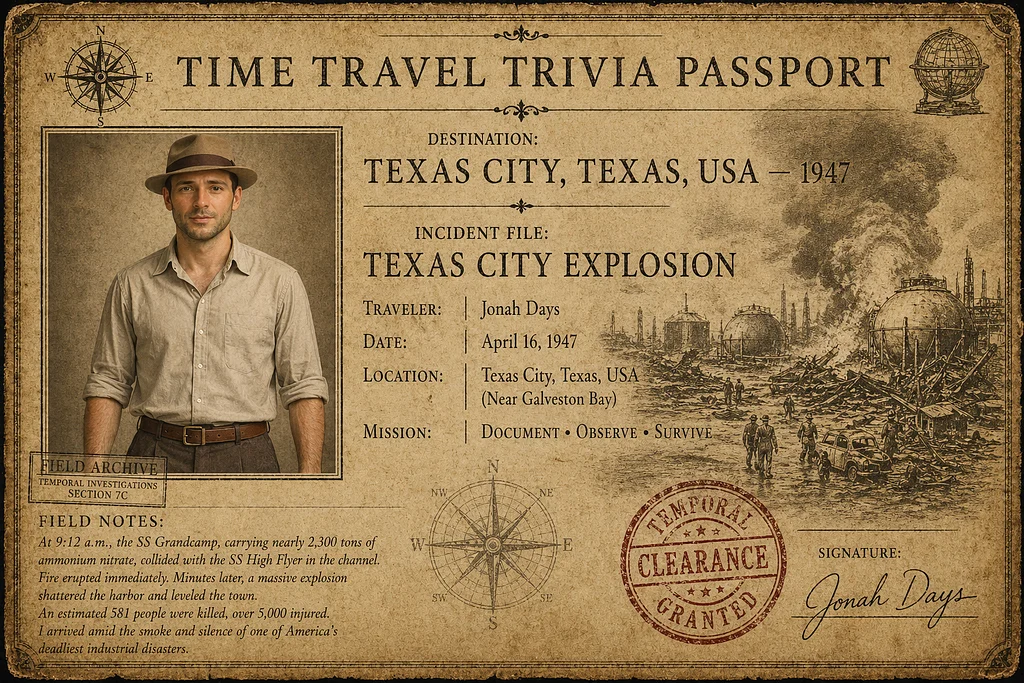
TEXAS CITY EXPLOSION
This authorization documents Jonah Days’ presence at the Texas City port complex on April 16, 1947, shortly before fire aboard the SS Grandcamp, loaded with approximately 2,300 tons of ammonium nitrate fertilizer, triggered a catastrophic detonation within the harbor district. The blast generated a shockwave equivalent to several thousand tons of TNT, flattening nearby warehouses, refineries, and residential zones within seconds. Secondary explosions followed as adjacent chemical storage facilities ignited, producing sustained fires across the industrial waterfront. Dockside rail infrastructure twisted under pressure effects, and anchored vessels were thrown ashore by displacement waves within Galveston Bay. Casualty records confirm at least 581 fatalities and more than 5,000 injuries, with over 1,000 buildings destroyed or severely damaged across the city.









ETHIOPIAN LOCUST PLAGUE
This passport entry verifies deployment across Ethiopian highland agricultural regions during the 1959 desert locust upsurge, when successive breeding cycles under favorable seasonal rainfall produced swarms numbering in the billions across East Africa. Dense migrating bands advanced rapidly over cropland and pasture, consuming cereals, legumes, and forage vegetation within hours of arrival. Entire harvest zones were stripped bare, forcing emergency grain redistribution across affected provinces. Rural transportation routes became temporarily impassable beneath airborne swarms, while livestock losses increased due to pasture depletion. Regional monitoring stations recorded swarm fronts extending dozens of miles in width, with long-distance migration continuing into neighboring territories. Archive assessments confirm widespread food insecurity conditions affecting millions of residents across multiple agricultural districts.








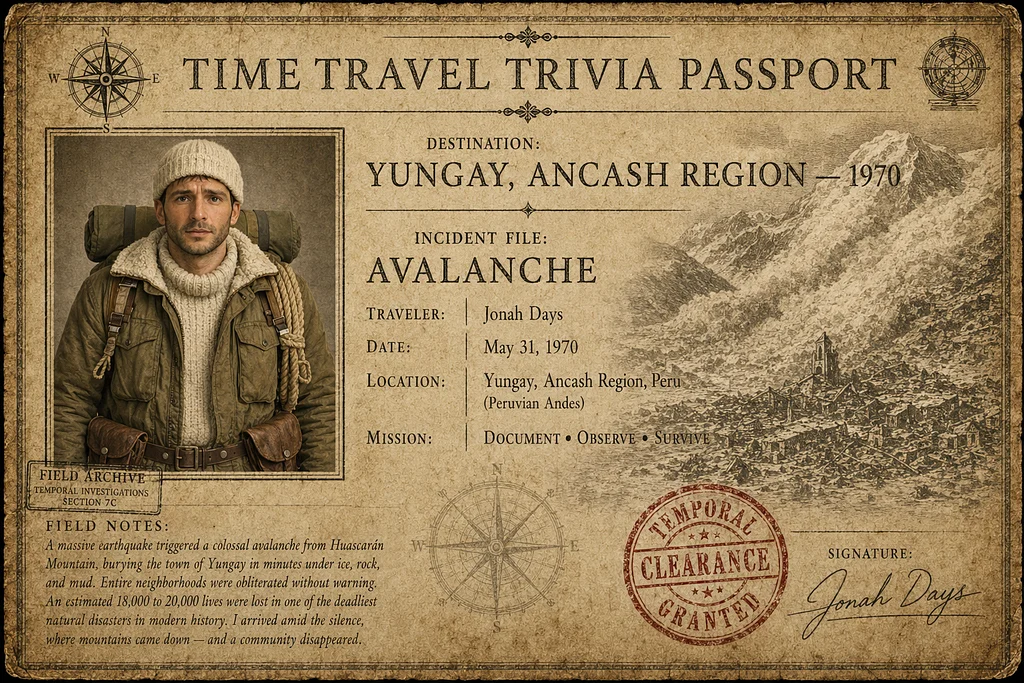
HUASCARÁN AVALANCHE
This record places Jonah Days in the Santa River Valley on May 31, 1970, immediately following the magnitude 7.9 Ancash earthquake that destabilized the north face of Nevado Huascarán and released a massive ice-rock avalanche toward the town of Yungay. The descending debris flow traveled at estimated speeds exceeding 300 kilometers per hour, entraining glacial ice, boulders, and saturated sediment as it crossed the valley floor. Entire neighborhoods were buried beneath deposits tens of meters deep within minutes, leaving only elevated structures visible above the debris field. Transportation routes across the region were severed as landslides blocked highways and river channels. Fatality estimates range between 18,000 and 20,000 residents in Yungay alone, making the event one of the deadliest mass-movement disasters in modern Andean history.